+233 26 292 9455 | +233 277 748 891
+234 708 447 7106 | +234 812 407 2652
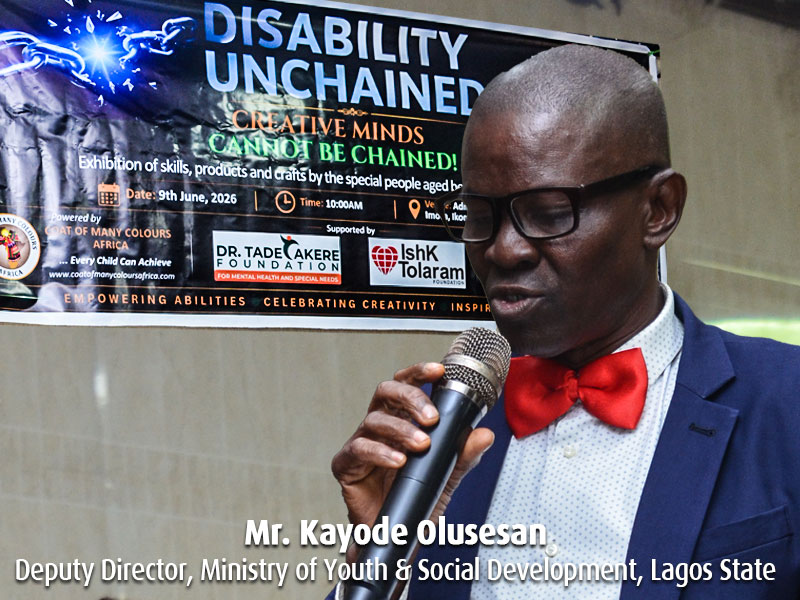
Mr. Kayode Olusesan
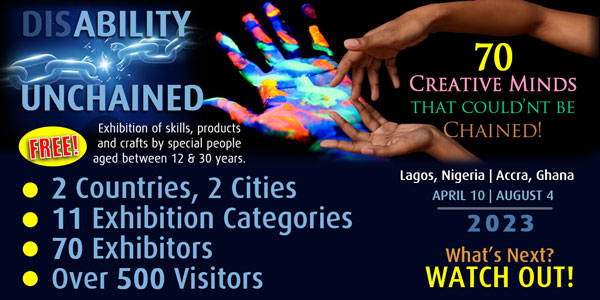
A PAPER PRESENTATION AS A GUEST SPEAKER AT COAT OF MANY COLOURS AFRICA’S DISABILITY UNCHAINED PROGRAMME ON JUNE 9, 2026 AT IMOTA, LAGOS STATE, NIGERIA
Disability affects every society and cuts across age, gender, ethnicity, languages, race and all areas of humanity. Currently our communities view persons with challenges as people needing charity. What we need to know is that persons with challenges are individuals capable of contributing significantly to the development of our society and beyond.
This programme aims to create a much desired awareness for individuals, parents, families, non-governmental organisations, private and public enterprises, governments and all peoples’ responsibility to support the dignity, rights and well-being of persons with challenges. This includes taking actions that support the aspirations of people with challenges; breaking down policy silos by integrating social policies to match the real and complex needs of communities and promoting societal and cultural change and emphasise that ‘disability should now equal diversity, and no longer a disadvantage’.
In our commitment to human rights, we should prioritise a holistic understanding of the person, seeing their impairment as only one aspect of what makes them who they are. This view is driven by a deep belief in the inherent worth of all human beings and their inalienable right to dignity and self-determination.
At this juncture, disabilities are usually grouped by the type of impairment and how it affects functioning. The main categories used globally and in Nigeria’s Discrimination Against Persons with Disabilities (Prohibition) Act 2018 are as follows:
1. Physical Disabilities
These are impairments affecting mobility, dexterity or physical functioning, such as spinal cord injury, amputation, cerebral palsy, muscular dystrophy, arthritis, dwarfism. The impact on such persons are difficulty in walking, using of hands, maintain posture, or controlling movements.
2. Sensory Disabilities These are impairments affecting sight, hearing, or both. This is broken into visual impairment/blindness, which is total or partial loss or sight. Hearing impairment/deafness which is total or partial loss of hearing. ‘Deaf and dumb’ is outdated; many use sign language and can communicate/write.
3. Intellectual/Development Disabilities When we talk about limitations in intellectual functioning and adaptive behaviour that appears before age 18. Examples are Down syndrome, intellectual disability, autism spectrum disorder, fetal alcohol syndrome. Its impact are challenges with learning, reasoning ability, problem-solving, communication, and daily living skills. People with Down Syndrome attend school, participate in decisions that affect them, have meaningful relationships, vote and contribute to society in many wonderful ways. Though, they experience cognitive delays, but the effect is usually mild to moderate and is not indicative of the many strengths and talents that each individual possesses.
4. Mental/Psychosocial Disabilities These are conditions affecting thought processes, mood, cognitive reasoning, and behaviour. Examples are, depression, bipolar disorder, schizophrenia, anxiety. Its impact can affect concentration, social interaction, work and self-care.
5. Neurological Disabilities These are disorders of the nervous system that may overlap with other categories. Examples suffices in epilepsy, multiple sclerosis, Parkinson’s disease, stroke-related impairments, and cerebral palsy. Its impact is felt in movement, cognition, sensation and speech.
6. Chronic Health/Non-Visible Disabilities These are long-term medical conditions that aren’t immediately obvious but limit functioning. Examples are sickle-cell disease, HIV, diabetes, asthma, chronic pain and cancer. Its impact can be felt on fatigue, pain, need for frequent treatment, and unpredictable flare-ups.
7. Multiple Disabilities When a person has two or more of the above, for example when a person with cerebral palsy is down with intellectual disability or deaf or blindness.
Ways Forward in Skills and Entrepreneurship Development
These categories matter because they help in tailoring support, assistive devices, training, and workplace adjustments. But within each category, ability is identified and varies a lot from person to person.
Here’s the breakdown for each category, focused on low-cost, marketable skills that work in Nigeria right now:
Conclusion
In the final analysis, I urge the parents/guardians of persons with challenges to speak up, speak out and reach out. Simply because the paradigm is shifting from ‘fix the person’ to ‘design the environment, training, and coming up with business model around their abilities. It is now matching their skills to what the person can do consistently, and not what he can’t do.
Therefore, make use of Lagos State Office for Disability Affairs (LASODA), being supervised by Lagos State Ministry of Youth and Social Development, Block 18, Alausa Secretariat, Ikeja. The aim of LASODA is safeguarding Persons Living with Disabilities (PWDs) against all forms of discrimination and equalization of their rights in all aspects of living in the society. The Ministry of Wealth Creation and Employment is also very supportive by offering vocational empowerment, trainings and full employment to the vulnerable in the society.
At this juncture, Coat of Many Colour Africa deserves our applause for the initiaitive by coming up this great idea to showcase acquired skills of the vulnerable with the understanding that their potentials aimed to bring a good source of livelihood for a better and more purposeful life.
Thank you for your attentio
Kayode Olusesan (Mr.)
Deputy Director, Ministry of Youth and Social Development, Lagos State
9th June, 2026
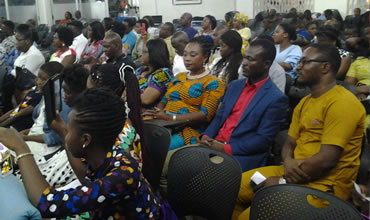
We organise programmes that aim at enlightening stakeholders in charge of raising children and persons who would be confident in their display of potentials and God-given talents.
Read more »
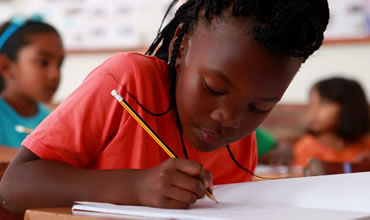
We are able to arrange for relevant practitioners to carry out assessment and evaluation of a child’s intellectual ability as well as that of the workforce.
Read more »
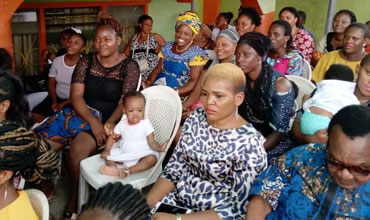
We organise seminars, workshops and activities that educate the parents and educators on various developmental issues affecting the industry.
Read more »
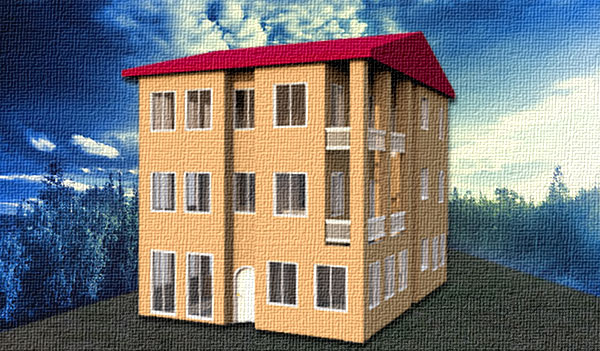
The Centre is conceived to be an all-inclusive skill acquisition vocation and personal development centre. Anyone who desires to learn a vocation and/or develop entrepreneurial skill especially children and people with mild physical
or mental/learning challenges.
This has become necessary because we found out that we are in an age of inclusion. Most private vocation centres rarely want to accept students with challenges or learning difficulty even as
we are in an age of inclusion in the education sector.
Read more »
People get involved by helping to spread awareness, raise donations and volunteering their skills.
 Mc.Rufus Interactive Design